Great Mention in Library Journal

I haven't blogged much yet about The Poacher's Son because very few people have read it at this point, and I think there will be time enough for me to talk about the book after it finally gets into bookstores. That said, in addition to the early reviews, my novel has started to get other mentions as more advance galleys make the rounds. This one, from Chris Vaccari, at Library Journal, really made my week.

I also picked up a great new mystery, Paul Doiron's The Poacher’s Son. A Maine game warden navigates strained relationships with the woman he loves and his father, who has been suspected of murder. Think Skink from Hiaasen’s books except as a mean, alcoholic, manipulative troublemaker. OK, maybe don’t think Skink—Skink is fun. This guy ain’t. Anyways, you’ll feel like there’s a black bear in the room while you chase through the woods to find a man who may or may not be getting framed.

I’ve never been to Maine, but now I feel like I have. Twigs were cracking underneath my feet as I settled in to read this one. Doiron creates great scenery to surround an impressive debut. Well done, sir.

Being compared to Carl Hiassen in any way shape or form is pretty cool, I have to admit.
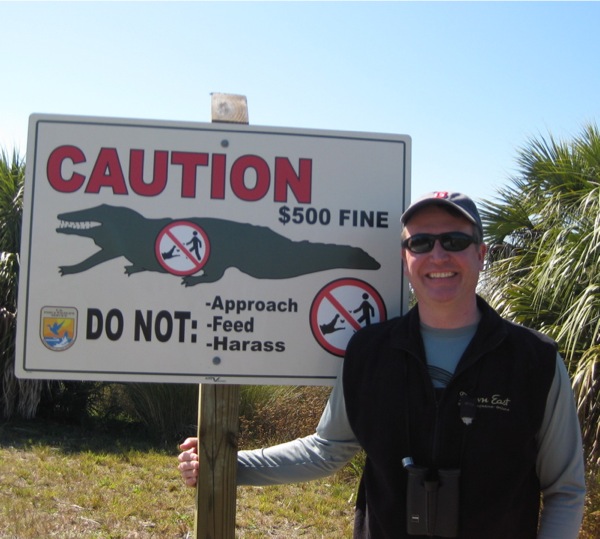
Please Don't Feed the Gators

American alligators were widely poached in Florida until the 1960s, but their numbers have rebounded to the point where the state has to actively mediate human interactions with the more than 1 million gators residing in Florida. Still, you'd think a word to the wise should be sufficient.

Evidently not according to this sign on Sanibel Island.

The King Died and Then The Queen Died

In his book Aspects of the Novel, E.M. Forster writes:

"The king died and then the queen died" is a story. "The king died and then the queen died of grief" is a plot... "The queen died, no one knew why, until it was discovered that it was through grief at the death of the king." This is a plot with a mystery in it, a form capable of high development.

To that I would add, "Everyone thought that the queen had died of grief until they discovered the puncture mark in her throat." That is a murder mystery, and it too is capable of high development.

—P.D. James, Talking About Detective Fiction

The Power of Twitter

Last week it looked like Walter Kirn, who wrote the novel Up in the Air, upon which the hit movie was based, would be watching the Academy Awards from his living room. Kirn, you see, hadn't been invited to the Oscars, despite the fact that screenwriter Jason Reitman was up for a Best Adapted Screenplay award. Kirn retaliated against Paramount Pictures, who should have issued the invitation, on Twitter:

In a message Kirn posted on Wednesday (17Feb10), Kirn wrote, “Caution to writers: Don’t expect that because you write a novel that becomes an Oscar-nominated film that you’ll be invited to the Oscars. Novelists are like oil in H’wood (Hollywood): they drill us, pipeline us, pump us and then burn us.”

But movie bosses have moved quickly to settle the issue, giving Kirn a prime seat next to the film’s star, [George] Clooney.

Kirn confirmed his invitation via Twitter.com on Friday (19Feb10), writing: “Thanks to Paramount Pictures for coming through with Oscar tickets and proving true to its word, which I shouldn’t have doubted.”

Whoever said that all publicity is good publicity was wrong—at least in the era of Twitter.