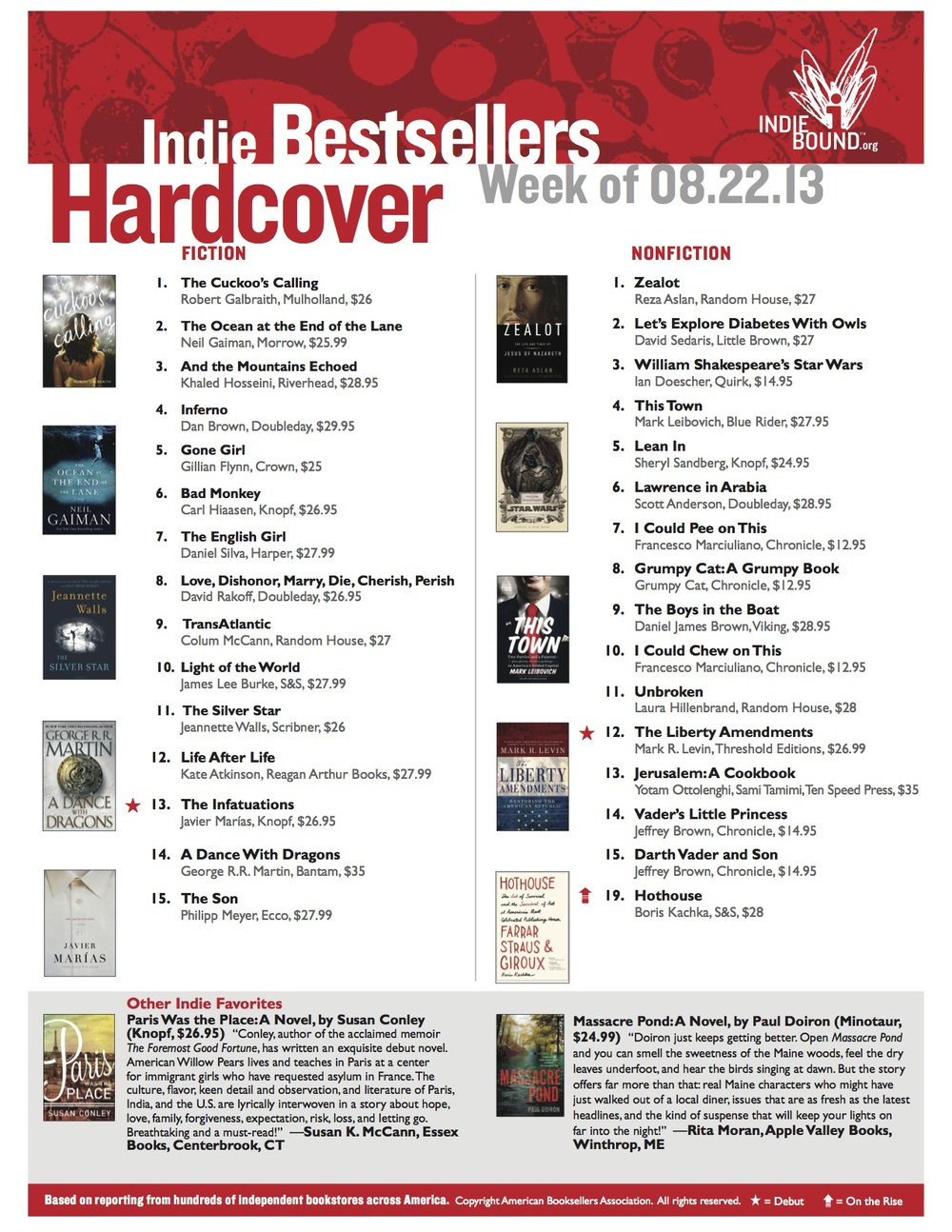
I read the recently published interview in the Maine Sunday Telegram about your new book. Your novel looks very interesting and I look forward to reading it. As a co-founder of RESTORE: The North Woods, I have a particular connection to some of the issues you touched on in the interview. I was especially struck by this comment: "[Roxanne Quimby's] property is right next to Baxter State Park, which is largely managed very well, especially compared to national parks, which have a lot more stress."
I have been involved in national park issues for almost three decades. I have visited more than 240 National Park System units. I have worked with scores of National Parks staff, historians, economists, and volunteers. I have long been familiar with the management of Baxter State Park, as well.
I agree that Baxter State Park is well managed. However, your unfavorable comparison of national park management with that of Baxter Park does not square with my experience. National parks are still considered “America’s best idea” for good reason. Despite some funding challenges in recent years, all of the National Park System units I have visited have offered a stellar visitor experience.
It is difficult to compare Baxter State Park with any other park. Baxter Park is unique in many respects. It certainly is unlike any other state park in Maine. Of course, this is what Percival Baxter intended and which is why it is not part of the Maine State Park system.
While it is difficult to make direct comparisons between Baxter State Park and Acadia National Park, people often do. You are obviously very familiar with Acadia National Park, since the cover story of this month’s issue of Down East magazine is about the “15 Reasons We Love Acadia.”
Acadia is one of the smallest and most popular of our national parks with more than 2 million visitors per year. Acadia has been managed as a national park for almost 100 years. Baxter State Park is more than five times the size of the main part of Acadia on Mount Desert Island, but it has only 3 percent as many visitors each year. If Baxter Park managers had been faced with 33 times more annual visitors for a century, I wonder if they would have been able to protect Baxter while making it the foundation of a vibrant economy as the National Park Service has done with Acadia.
An objective comparison between Acadia National Park and Baxter State Park would likely be unfavorable to Baxter, because as a national park, Acadia has far more resources available to it. These additional resources allow Acadia to generally better maintain facilities, roads and trails, and transportation systems. They have allowed Acadia to put in place public transportation to reduce private vehicle use, while Baxter has not been able to get past the discussion stage. They have enabled Acadia to employ many more staff, provide a higher level of training, offer comprehensive interpretive programs, and provide more official integration of local communities in park planning. When comparing these factors, it is difficult to draw the conclusion that Baxter State Park is better managed than Acadia National Park from the standpoint of infrastructure, operations, and programs.
A more analogous comparison can be made between Baxter State Park and national parks in terms of wilderness protection, which does not require extensive resources. Washington's Mount Rainier National Park, established in 1899, is slightly larger than Baxter State Park, which was established in 1931. Mount Rainier welcomes 1.8 million visitors each year — probably more than Baxter has experienced in all the years since its establishment. Despite accommodating tens of millions of visitors over 114 years, the National Park Service has kept Mount Rainier remarkably intact. In fact, 97 percent of Mount Rainier is congressionally designated as Wilderness, while only 86 percent of Baxter Park is designated as sanctuary.
Many people think of crowded Yosemite Valley when they think of Yosemite National Park. Yosemite is about four times larger than Baxter, but it receives 4 million annual visitors — 70 times more than Baxter. Yosemite Valley can be congested on peak days, but it only covers about 4,500 acres of the 761,266-acre park. Moreover, although Yosemite National Park has been a popular destination since its establishment in 1890, nearly 90 percent of the park is designated as Wilderness. It is easier to find a remote backcountry experience in most of Yosemite than in much of Baxter in the summer.
I sometimes hear people say that world-famous Yellowstone National Park is overdeveloped and overused. However, after 141 years of national park management, 92 percent of Yellowstone still meets national Wilderness criteria. For example, the remote, little-known Bechler region in the southwest portion of Yellowstone is twice the size of Baxter State Park. With no roads, no facilities, and few visitors, this vast wildland is certainly less stressed than Baxter Park.
By a different measure, positive economic impact, no other type of land protection can rival national parks. Mount Desert Island is the crown jewel of the Maine Coast, and Acadia National Park makes tens of thousands of acres on the island accessible to the public for world-class educational, interpretive, and recreational programs. Acadia generates $186 million in economic activity annually for mid-coast Maine. According to a 2008 study by the University of Maine at Presque Isle, Baxter generates less than $7 million in direct and indirect visitor spending. If the goal is to spur economic prosperity, as it is for many people in the struggling towns of northern Maine, a national park is a far greater draw than any state park, even Baxter.
Several studies, including a couple released earlier this year, have shown that a national park in northern Maine could greatly help supplement and help diversify the economy of that struggling region.
An analysis by a nationally recognized resource economist of our original 3.2-million-acre Maine Woods National Park & Preserve found that over a 20-year period, while the park was gradually put into place, it could have a net positive impact, bolstering the state’s economy with $109 million to $435 million in annual retail sales and supporting 5,000 to 20,000 jobs. Meanwhile, about 90 percent of Maine’s annual tree harvest would be unaffected and could be made up with better forest management in other areas.
Similarly, studies of the likely impact of the lands Roxanne Quimby has offered to donate for a national park and recreation area have concluded that more than 1,000 new private and public sector jobs could be created as the region was diversified with a new park.
Other studies have shown that every dollar invested in national parks generates at least four dollars in economic value to the public, supporting approximately $13 billion of local private-sector economic activity and nearly 270,000 private sector jobs, plus thousands more public jobs, across our country.
In terms of recreation, our Maine Woods National Park & Preserve would guarantee public access for the full range of recreational activities. This includes hiking, hunting, fishing, camping, paddling, skiing, and snowmobiling. Roxanne’s proposed donation of lands too would provide for the same full range of activities.
I could go on, but I think you get my point. There are a lot of misconceptions about our national parks that get in the way of an accurate understanding of how important they are ecologically, economically, and for a wide variety of recreational activities.
Since your latest book seems to be sparking a renewed debate about the pros and cons of creating a new national park in the Maine Woods, you have an opportunity in interviews and on your book tour to provide accurate information about the benefits of national parks, and to dispel some of the misconceptions.

 Last year, when I was writing Massacre Pond, the conversation about whether the federal government should create a Maine North Woods National Park had softened to something less than dull murmur. The debate that had raged for years had grown very quiet. One of the reasons I wanted to write the novel was to jumpstart the discussion.